
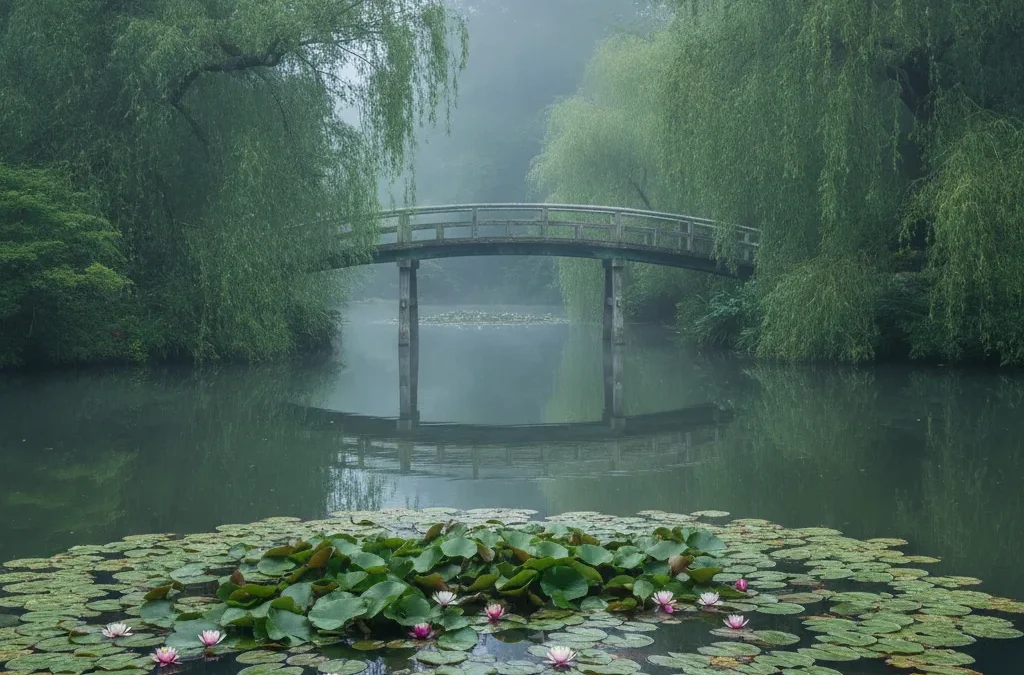
The story of the painting “Giverny” does not begin on a blank canvas. It begins in a Norman village on the banks of the Seine, where Claude Monet chose to settle in 1883 and spend the next forty-three years. The name “Giverny” has become much more than a place name: it is a pictorial motif, a state of mind, a way of perceiving light and the passage of time. Frédérique Lafourcade takes up this theme today, not to reproduce what Monet has already accomplished, but to extend its resonance through a resolutely contemporary sensibility. To understand the significance of this title is to understand why a work of art can transcend generations without ever growing old.
The Story Behind the Painting "Giverny": More Than a Tribute to Monet, a Reinterpretation of Memory
Reading time: ~7 min
- History of the Painting "Giverny": From Impressionist Motif to Contemporary Reinterpretation
- Giverny: From a Norman Village to an Impressionist Legend
- The History of the Paintings Created in Giverny: A Journey Toward Abstraction
- “Giverny” by Frédérique Lafourcade: A Contemporary Work Rooted in This Heritage
- FAQ
- Giverny, a living motif between memory and reinterpretation
History of the Painting "Giverny": From Impressionist Motif to Contemporary Reinterpretation
The story behind the painting *Giverny* spans the period from the emergence of the motif in Claude Monet’s work to its reinterpretation by Frédérique Lafourcade. From the gardens of Giverny to contemporary painting and collage techniques, this same place thus serves as a common thread linking Impressionism and abstraction, the observation of nature and the work of memory.
Giverny: From a Norman Village to an Impressionist Legend
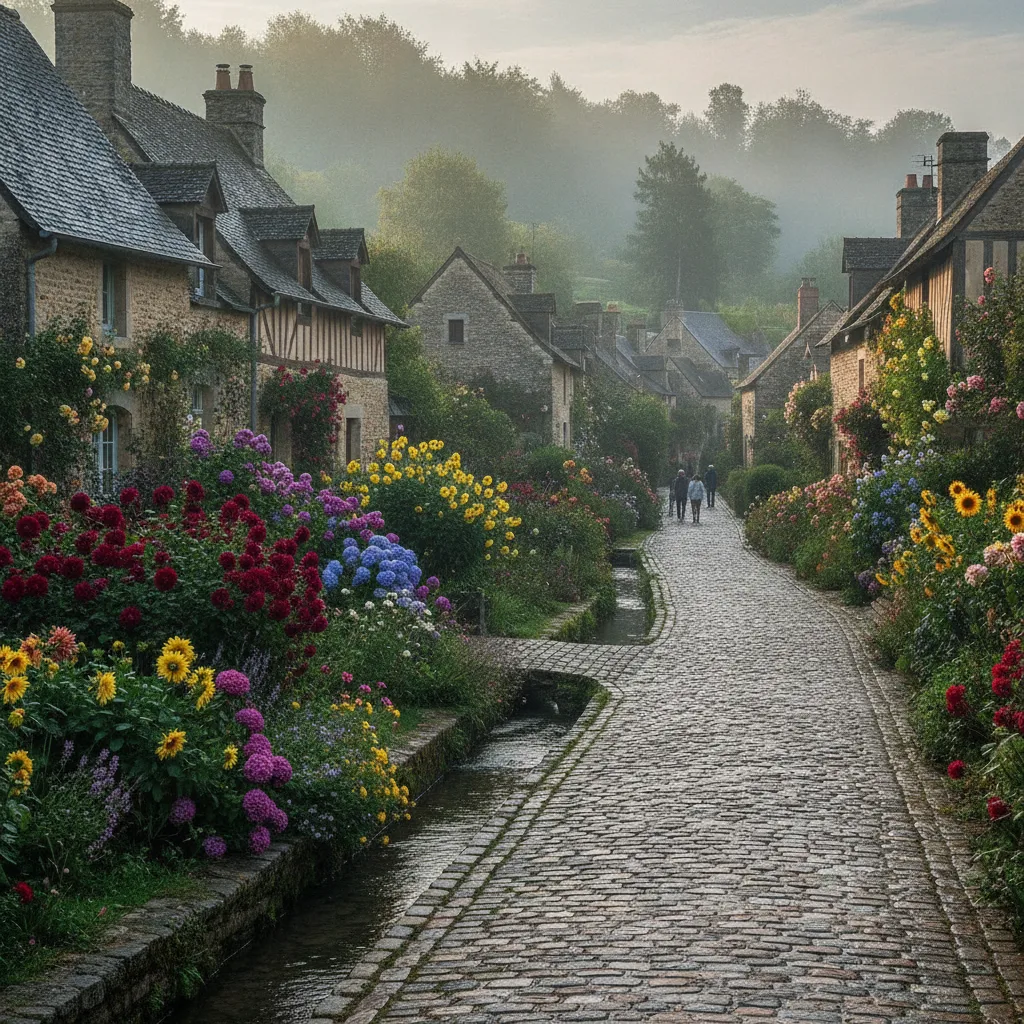
Before Monet settled there, Giverny was a farming village in the Eure department of Normandy, located on the right bank of the Seine, about seventy kilometers from Paris. At first glance, there was nothing to suggest that this village would become one of France’s most visited cultural sites. It was the painter’s arrival that would change everything.
Monet first rented a house with a large orchard before purchasing it in 1890. He gradually transformed it into two distinct spaces: an enclosed garden planted with flowers in front of the house, and then a water garden with a pond, water lilies, and a Japanese bridge, fed by a branch of the Epte River. This second space was not merely an ornamental garden. It was an open-air studio, designed to be painted. Monet literally invented his landscape, playing with it according to the seasons, the time of day, and the weather conditions. Giverny is not merely depicted: it is crafted like a living painting.
The early paintings of Giverny depict the village itself, its fields, and its ever-changing skies. “Sunset at Giverny” (1883) and “Entrance to Giverny in Winter, Sunset” (1885) reflect this period of exploration, during which Monet sought less to describe a place than to capture its fleeting atmosphere. The light of Normandy—its mists, its biting cold, and its sudden springs—became the true subjects of these works.
The History of the Paintings Created in Giverny: A Journey Toward Abstraction
From the Observed Landscape to the Inner Motif
What makes the history of the Giverny paintings so fascinating is the trajectory it traces. Monet begins with a faithful observation of the landscape and gradually moves toward something more internal, more sensory. The water garden became the laboratory for this evolution. The reflections on the pond, the water lilies floating without any apparent anchor, the vegetation stretching out into blurred edges—all of this pushed Monet toward a gradual dissolution of form.
This approach does not represent a departure from reality. It is an intensification of sensory experience. The painter no longer seeks to depict what the eye sees, but rather what memory and emotion retain from a vision. It is precisely this shift—from the perceived to the felt—that links Monet’s work to contemporary non-figurative painting.
The Water Lilies: The Culmination of a Lifetime in Giverny
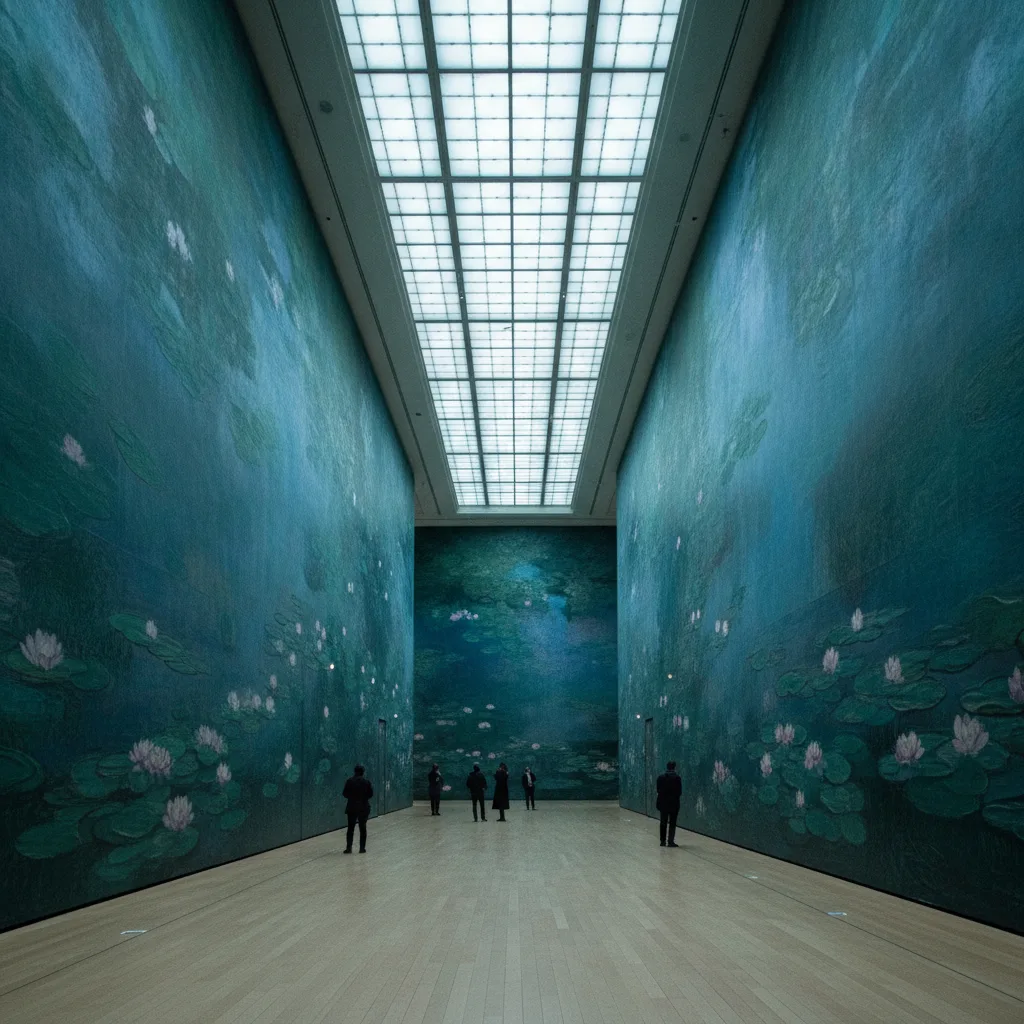
Beginning in the 1890s, Monet devoted himself almost exclusively to the Water Lilies series. These paintings, whose panoramic and monumental versions are now housed at the Orangerie in Paris, depict water, reflections of the sky, water lilies, and sometimes the Japanese bridge and the surrounding vegetation. They embody the culmination of an exploration of light, color, and the dissolution of form that occupied his entire life in Giverny.
What Monet achieved with the *Water Lilies* is a form of abstraction ahead of its time. The surface of the pond becomes a space without a horizon, without classical perspective, without narrative. The eye can no longer tell where the water begins and the sky ends. This visual experience—both unsettling and soothing—is what one might call the promise of Giverny: a place where the boundary between the external world and the inner world dissolves.
Giverny: An Artists’ Colony with International Reach
Monet’s influence on the village extends beyond his own work. Beginning in the late 19th century, Giverny attracted many painters, including American artists who had come to Europe to study and experiment with new approaches to landscape painting. The village became an international artists’ colony, a place where pictorial traditions and formal experimentation in the open air converged.
Some researchers have examined how Giverny has gradually become entrenched in a heritage narrative centered on Monet, at the risk, at times, of oversimplifying the historical complexity of what actually took place there. This tension between myth and reality, between homage and oversimplification, is itself an invitation to view Giverny in a different light—to reinterpret its legacy rather than merely reproduce it.
“Giverny” by Frédérique Lafourcade: A Contemporary Work Rooted in This Heritage
When Memory Becomes Artistic Material
Frédérique Lafourcade’s painting “Giverny” does not seek to recreate what Monet painted. It is part of a contemporary non-figurative approach to painting and collage, in which the name of the place serves as a trigger for memory rather than a descriptive subject. Giverny is not depicted: it is evoked, summoned, and reinterpreted through layers of material, color, and texture.
This approach echoes what the great masters of contemporary abstract painting have been exploring for several decades. Gerhard Richter, Pierre Soulages, and Sean Scully—each in their own way—have shown that non-figurative painting can convey an emotional and memorial charge as intense as that of the most faithful representation. What Frédérique Lafourcade brings to this dialogue is a particular sensitivity to time, light, and the layering of lived experiences.
The Technique of Collage as an Archaeology of Memory
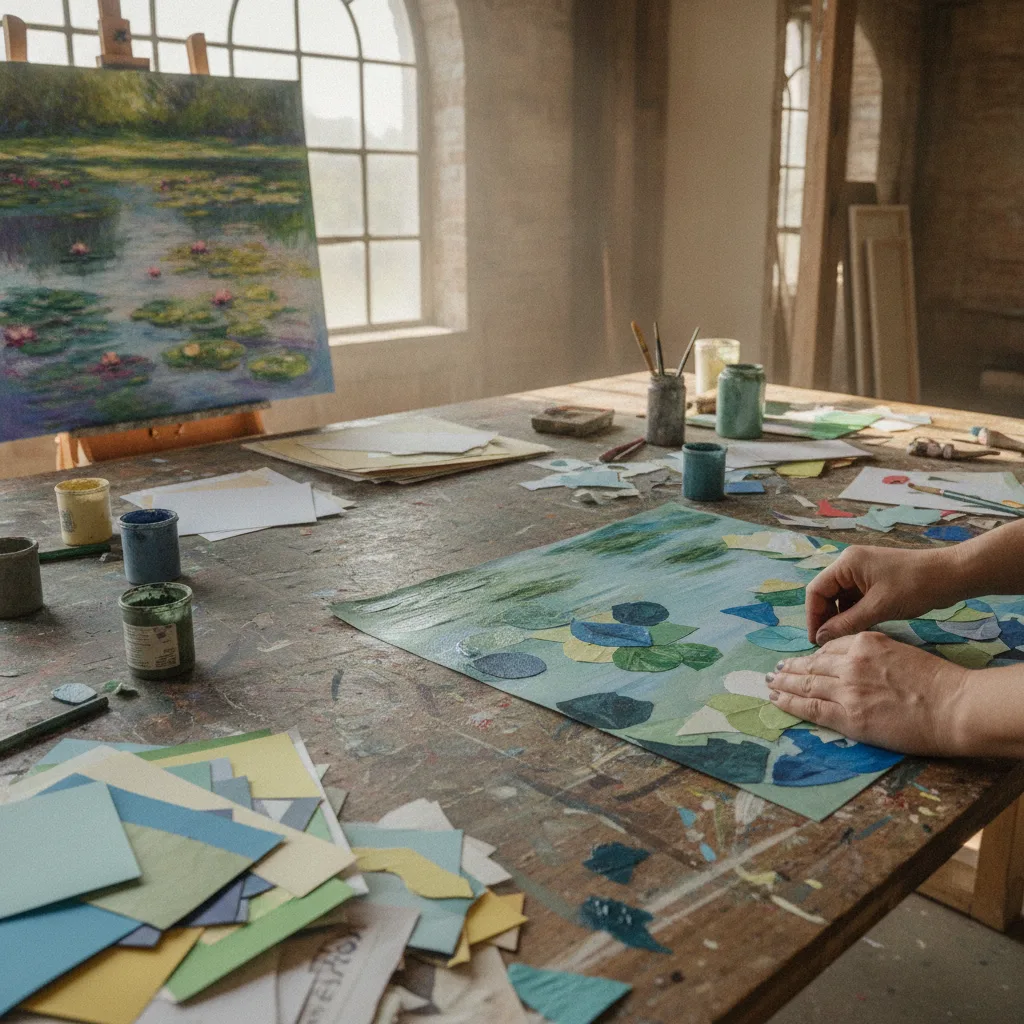
In Frédérique Lafourcade’s practice, collage is not a decorative technique. It is a way of working with memory through accumulation, of layering elements just as one would layer memories. The material—added, crumpled, and integrated into the paint—creates relief, areas of light and shadow, and tensions between the smooth and the rough. This texture is, in itself, a narrative.
When applied to the Giverny motif, this technique captures what the place has imprinted on the collective imagination without simply replicating it. The work does not resemble Monet’s gardens. It carries their resonance, like a distant yet distinct echo. That is the very difference between homage and reinterpretation.
Among the artist’s other works that share this same concept of resonance and memory are “L’heure bleue, ” “Un matin d’hiver,” and “Les quais de Seine,” each of which explores, in its own way, the relationship between a place, light, and the impression they leave on the viewer’s sensibility.
| Appearance | Giverny at Monet's | "Giverny" by Frédérique Lafourcade |
|---|---|---|
| Relationship to Place | Direct observation of the village, the gardens, the water garden, and how they change throughout the seasons. | A place described as a trigger for memories, without any descriptive depiction of the gardens or the village. |
| The Treatment of Light and Time | A search for fleeting light, shifting atmospheres, and the gradual dissolution of form. | An exploration of light and time through the layering of materials, colors, and lived experiences. |
| Artistic Approach | Impressionist painting that moved toward a form of abstraction ahead of its time with the *Water Lilies*. | Contemporary non-figurative painting and collage, focusing on memory, emotion, and the resonance of the motif. |
FAQ
Why is a contemporary painting titled “Giverny” if it doesn’t depict Monet’s gardens?
In non-figurative contemporary art, the title of a work often serves as an emotional entry point rather than a description. “Giverny” evokes a world, a light, and an atmosphere steeped in art history. The artist draws on this collective resonance to create a dialogue between the memory of the place and his own sensibility, without seeking to replicate what Monet accomplished.
What is the difference between Impressionist painting in Giverny and the contemporary abstract art that draws inspiration from it?
Impressionist painting in Giverny is based on direct observation of nature and seeks to capture its fleeting light. Contemporary abstract painting that draws inspiration from Giverny is rooted in memory, emotion, or the cultural resonance associated with the name. It does not depict the place itself, but rather conveys the effect it has on the viewer’s sensibility. It is a transition from the visible to the felt.
How can the story behind the painting “Giverny” enrich the experience of a contemporary art collector?
Understanding the history of the Giverny motif—from Monet’s earliest paintings to contemporary reinterpretations—allows collectors to grasp the full depth of a work that references it. A painting is not merely a visual object; it carries a lineage and engages in a dialogue with art history. To own such a work is to become part of that conversation.
Giverny, a living motif between memory and reinterpretation
From Monet painting his water lilies at dawn in Normandy to Frédérique Lafourcade working with materials and collage in her studio, Giverny remains a living subject, capable of reinventing itself with each generation. What the history of these paintings teaches us is that the places most steeped in meaning are those that resist reproduction and call for reinterpretation. To discover Frédérique Lafourcade’s entire body of work and explore the full gallery, there’s only one place to go: fredlafourcade.com.