
For centuries, Japanese art has fascinated and inspired creators around the world. For me, this fascination is not merely an aesthetic stance: it is a deep, visceral source of inspiration from Japanese art that has transformed the way I paint, compose, and allow the canvas to breathe. Wabi-Sabi and Ma are not merely abstract philosophical concepts; they are living tools, interpretive frameworks that I apply daily in my studio. This article invites you to understand how these two fundamental principles of Japanese culture have shaped my work and why they resonate so powerfully in contemporary non-figurative painting.
The Influence of Japanese Art, Wabi-Sabi, and the Concept of "Ma" in My Paintings: A Journey to Japan
Reading time: ~6 min
Table of Contents
- Wabi-Sabi: The Aesthetic of Imperfection and Transience
- Le Ma: When Emptiness Becomes Language
- Japanese Influence in Western Painting: A Long History
- How these principles are reflected in my paintings
- The Influence of Japanese Art on My Contemporary Painting
- FAQ
- Wabi-Sabi and Ma: A Way of Experiencing the Web
Wabi-Sabi: The Aesthetic of Imperfection and Transience
Understanding Wabi-Sabi in Japanese Art
Wabi-Sabi is one of the most difficult concepts to translate from Japanese, and that is precisely what makes it so rich. It refers to an aesthetic sensibility based on the acceptance of imperfection, incompleteness, and the passage of time. Where classical Western thought seeks symmetry, formal perfection, and permanence, Wabi-Sabi celebrates the crack in a ceramic, the patina of wood, and the decaying leaf.
Applying Wabi-Sabi to Contemporary Painting
In painting, this philosophy translates into a rejection of an overly polished finish. A slightly grainy surface, a layer of material that reveals the layers beneath, a color that is not entirely uniform: these are all marks of time and the artist’s touch that give the work its authenticity. It is this same logic that we find in Japanese raku ceramics, where the irregularities of the firing process are considered qualities rather than flaws.
For a collector with an appreciation for contemporary art, Wabi-Sabi offers a valuable lens through which to view art. It explains why certain works seem “alive,” why a painting can appear both ancient and resolutely modern. Imperfection is not a flaw: it is an invitation to contemplation, a space where the viewer’s gaze can settle and construct its own meaning.
Le Ma: When Emptiness Becomes Language
Ma: An Inhabited Void in Japanese Art
Ma (間) is an even more fundamental concept in Japanese aesthetics. It refers to the interval, the pause, the space between things. It is not emptiness as absence, but emptiness as an active presence, as a compositional element in its own right.
Ma and the Evolution of Western Painting
European Impressionists discovered this concept during the Japonism movement in the late 19th century, when prints by Hokusai and Hiroshige began circulating in Europe. It was a revelation. Whereas the Western pictorial tradition strove to fill space, construct perspective, and establish a hierarchy of planes, Japanese prints demonstrated that emptiness could be as expressive as a drawn form. Monet understood this in his gardens at Giverny, Van Gogh in his compositions with sharp contours and flat areas of color, and Klimt in his decorative motifs reminiscent of Asian ornamentation.
In traditional Japanese ink painting, sumi-e, the unpainted areas are not mistakes or omissions: they are moments of respite. They allow the eye to wander, to pause, and to move on. This concept of meaningful negative space profoundly changed the way Western artists subsequently approached framing, composition, and the hierarchy of elements on the canvas.
Japanese Influence in Western Painting: A Long History
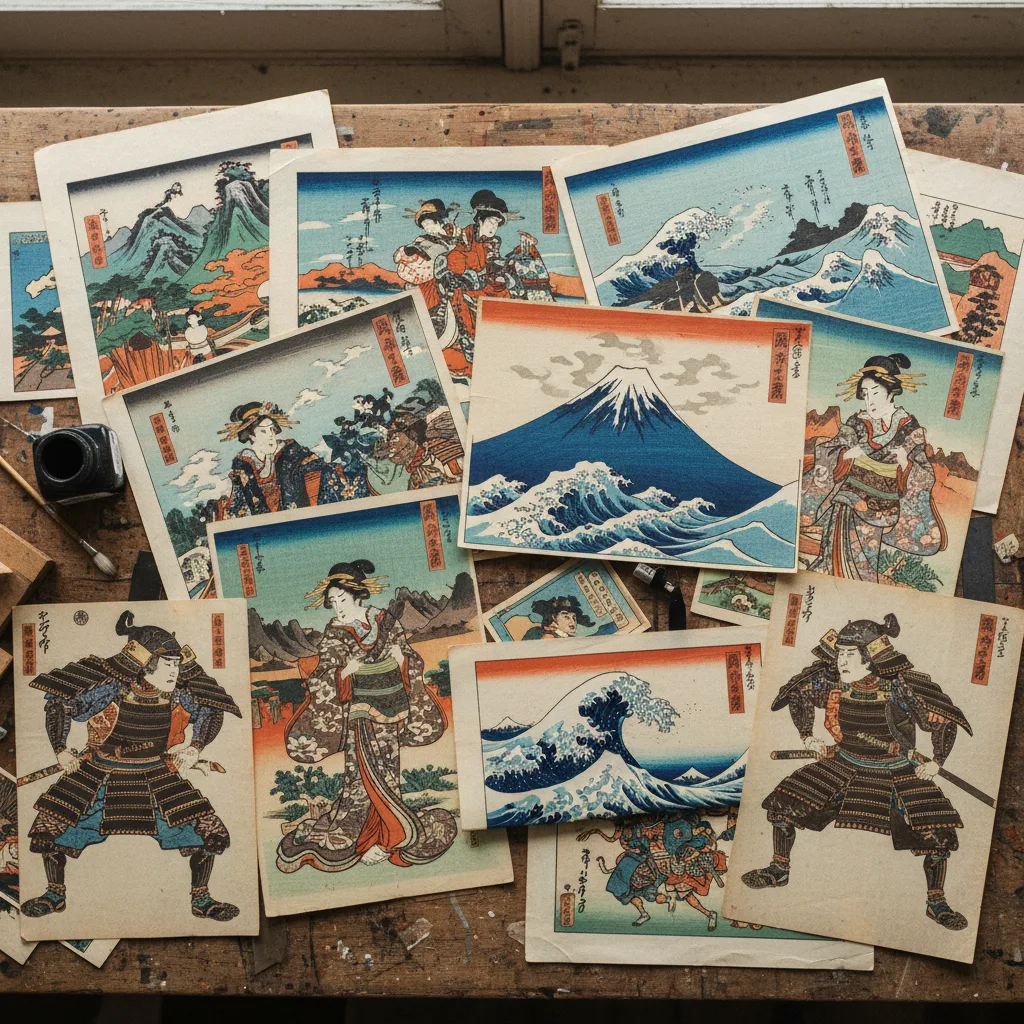
Japonism, a cultural movement that emerged in the late 19th century, is one of the most significant phenomena in the history of Western art. The massive influx of ukiyo-e prints into Europe sparked a veritable aesthetic revolution. Artists discovered asymmetrical compositions, flat areas of color without shading, and “cropped” frames where figures and landscapes seemed to leap out of the picture, as in a snapshot taken on the spot.
This influence did not end with Impressionism. It spanned the 20th century and continues to shape contemporary art. Artists such as Gerhard Richter, in his abstract series, or Sean Scully, in his compositions of colored bands, demonstrate a sensitivity to space and silence that is reminiscent of the principles of Ma. Anselm Kiefer, for his part, explores layers, materials, and the traces of time with an intensity that resonates with the spirit of Wabi-Sabi.
What is remarkable is that these influences do not read like direct quotations. They have been assimilated, digested, and transformed. That is exactly how authentic inspiration works: it does not copy; it metabolizes.
How these principles are reflected in my paintings
My work follows this approach. When I prepare a canvas, I don’t start with a specific subject in the figurative sense. I begin with an intention, a sensation, or sometimes a memory of a trip or a particular light. Japan has taught me to trust the unfinished stroke, the color that bleeds slightly, and the space left open.
In works such as *L’Heure bleue* or *Un matin d’hiver*, we find this tension between dense material and moments of breathing room, between what is said and what is left unsaid. The use of negative space is expressed here not as a decorative device but as a structural necessity: without these visual silences, the composition would lose its internal balance.
Wabi-Sabi, on the other hand, is evident in the treatment of surfaces. I often work in multiple layers, allowing the previous layers to show through, accepting that the canvas retains the memory of its own transformations. Works such as *The Wear of Time* or *Lapidary Marks* literally embody this philosophy in their titles and materials: they celebrate what time does to things, the beauty of what has lived.
My travels to Japan have deepened this sensibility. Tokyo, with its blend of modernity and tradition, with its Zen gardens nestled at the foot of skyscrapers, has taught me a lasting lesson in the coexistence of opposites. The Tokyo and Imperial Palace series are attempts to capture this experience: not by depicting places, but by capturing their atmosphere, their rhythm, and the space between things.
There is also an aspect of my work related to signs and traces, which can be seen in pieces such as *Écrits* or *Taches d’encre*. Japanese calligraphy has taught me that the gesture matters just as much as the result, that the mark left by the brush is in itself a form of writing by the body and the mind.
You can explore all of these works in the gallery and learn more about my artistic approach on the " About the Artist" page.
The Influence of Japanese Art on My Contemporary Painting
Over the years, Japanese art—through Wabi-Sabi and Ma—has become much more than an aesthetic reference for me: it is a common thread that connects my travels, my memories, and my daily practice in the studio. These principles inform the way I approach materials, time, and moments of silence in each painting.
| Concept | Principles mentioned in the text | Expression in my work |
|---|---|---|
| Wabi-Sabi | Acceptance of imperfection, incompleteness, and the passage of time; appreciation of marks and patina. | Grainy surfaces, layers of material revealing the layers beneath, textures that seem to tell a story. |
| My | Empty space as an active element, intervals, visual pauses, and breathing room in the composition. | Spaces left open, visual silences essential to the painting’s internal balance, unpainted areas that guide the eye. |
| Japanese Art and Western Painting | An introduction to ukiyo-e prints, a revolution in composition and flat color, and the lasting influence of Japonism. | The incorporation of these references through composition, the treatment of space and materials—not through direct quotation, but through an internal transformation. |
FAQ
What is Wabi-Sabi, and how does it apply to contemporary painting?
Wabi-Sabi is a Japanese aesthetic philosophy that values imperfection, incompleteness, and the beauty of things altered by time. When applied to painting, it manifests as a particular focus on textures, visible layers, and uneven areas. Rather than seeking a perfectly smooth surface or an ideally balanced composition, the artist accepts and incorporates the “accidents” of the creative process as expressive elements in their own right. It is an approach that gives the works a temporal depth and authenticity that formal perfection cannot produce.
What is the difference between Ma and the Western concept of emptiness?
In Western artistic tradition, emptiness is often perceived as a void to be filled, a gap in the composition. The Japanese concept of “ma,” on the other hand, views emptiness as an active presence, a space imbued with meaning. It is the interval between elements, the pause in the visual rhythm, the zone of silence that allows the eye to breathe and the mind to engage. This concept profoundly influenced the European Impressionists, who discovered, through ukiyo-e prints, that a painting could be more powerful precisely because it did not say everything.
How can one recognize Japanese influence in a non-figurative contemporary artwork?
The influence of Japanese aesthetics in abstract or non-figurative painting can be identified through several clues:
- the presence of voids or structural voids in the composition
- a focus on textures and materials, with surfaces that seem to have a history
- asymmetrical compositions in which balance is not static but dynamic
- an economy of means, where every element counts precisely because there isn't too much of it
These characteristics do not constitute a style that is immediately recognizable, but they create a sense of presence and stillness that discerning art lovers perceive instantly, even if they cannot always put a name to it.
Wabi-Sabi and Ma: A Way of Experiencing the Web
Wabi-Sabi and Ma are not formulas to be applied mechanically: they are ways of approaching the canvas, attitudes that profoundly transform the relationship between the artist, the artwork, and the viewer. They have taught me to trust the unfinished, to hear the silence between forms, to accept that the most enduring beauty is often that which bears the mark of time. If you wish to discover how these principles manifest themselves concretely in my creations, past and upcoming exhibitions will offer you the opportunity to experience them beyond the confines of a screen.